

There is a version of football betting that feels like research but is not. You open 3 tabs, scan some recent results, check the current handicap line, and place your bet with a vague sense that you have done your homework. Most bettors operate exactly this way — and most bettors lose money over the long run, not from bad luck, but from surface-level preparation dressed up as analysis. Keonhacai95.com takes a different approach. As a platform built around depth rather than speed, Kèo Nhà Cái 95 presents football betting analysis that goes several layers below what a standard odds board offers — connecting raw data to match context so users arrive at decisions that are actually grounded in something.
What Separates Detailed Analysis From Basic Odds Checking
Most people treat “analysis” and “checking odds” as the same activity. They are not, and understanding the difference changes how useful any Kèo Nhà Cái platform can be to you.
Checking odds tells you what the market currently thinks about a match. That is useful, but it is only 1 piece of information. Detailed analysis asks a harder follow-up question: do you agree with the market, and if so, why? If not, what specifically do you think the market is missing or overweighting?
This sounds straightforward. In practice, answering it requires pulling together several data streams simultaneously — current form filtered by opponent quality, injury and availability status, tactical matchup assessment, historical patterns in specific match contexts, and odds movement history. No single data point answers the question. The picture emerges from how they relate to each other.
The 5 Layers of a Properly Detailed Match Analysis
Detailed football analysis for Kèo Nhà Cái purposes is not about having more data. It is about working through the right sequence of questions. Here is how a structured approach looks in practice.
Layer 1 — Establishing the Baseline Picture
Before touching any statistics, answer 3 questions from memory or basic fixture information: Who is favored here and why? What is the likely match dynamic — open game or tactical, high-scoring or defensive? Are there any obvious contextual factors (derby match, cup fixture, end-of-season dead rubber) that would affect how either team approaches it?
This baseline takes 2 minutes and prevents you from approaching statistics without any analytical frame. Without it, you end up reading numbers without knowing which ones matter for this specific fixture.
Layer 2 — Form in Context, Not Raw Form
A team’s last 5 results tell you almost nothing in isolation. What matters is who they played, whether those were home or away fixtures, what the scorelines suggest about underlying performance, and how their current squad availability compares to those matches. A 4-match winning run built against bottom-half opposition before a fixture against a top-3 side is not the momentum signal it superficially appears to be.
Good Kèo Nhà Cái platforms surface this contextual layer alongside the raw form line. If yours does not, treat any form trend with significant skepticism until you have checked the opponent quality yourself.
Layer 3 — Injury and Availability Assessment
Single absences can shift match outcomes in ways that full-team statistics cannot capture. A first-choice defensive midfielder missing — the one who screens the back 4 and controls transition — creates a vulnerability that will not appear in a team’s defensive record from the previous 6 weeks. A striker who has scored in 5 of his last 7 home starts being listed as doubtful changes the attacking calculus entirely.
This is the layer where detailed analysis earns its keep most clearly. It requires current information — checked on match day, not 3 days prior — and it requires knowing which absences are structurally significant rather than just notable.
Layer 4 — Tactical Matchup Evaluation
Some teams have persistent tactical advantages or vulnerabilities against specific styles of play. A high-press side that struggles against patient, possession-based opponents. A team with an elite aerial presence that generates disproportionate threat from set pieces. A defensively deep side that absorbs pressure well but rarely creates enough to cover an Asian Handicap against quality opposition.
These patterns exist and persist across seasons — sometimes changing with managerial appointments, sometimes surviving them. Recognizing the relevant tactical dynamic for a specific fixture and checking whether the current Kèo Nhà Cái line reflects it is one of the more reliable analytical edges available to attentive bettors.
(Compiled with reference to match analysis at https://keonhacai95.com/)
Layer 5 — Odds Movement and Market Interpretation
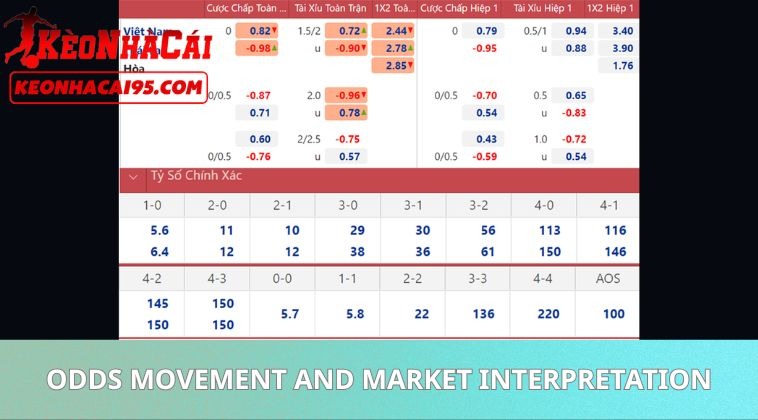
By the time you reach this layer, you have an independent analytical view of the match. Now you compare it against what the market is saying through its odds movement.
Has the handicap shifted significantly from opening? In which direction, and when did the movement occur? Did it happen immediately after opening — suggesting sharp early positioning — or gradually over 48 hours, which points more toward accumulating public sentiment? Did it move following a specific news event, or without any obvious public catalyst?
Each pattern suggests something different about why the line sits where it currently does. A line that has moved sharply away from your independent assessment is worth pausing on before acting. Either the market knows something you do not — in which case you should investigate — or the market is overreacting, which may represent genuine value in the direction your original analysis pointed.
Why Most Bettors Skip Detailed Analysis and What It Costs Them
Detailed analysis takes time. That is the honest answer for why most people do not do it. A casual 10-minute pre-match scan feels like enough when you are excited about a fixture and eager to place a bet.
The cost is invisible in the short run. Any individual bet can win or lose regardless of preparation quality. Variance masks the impact of poor analytical process across dozens of bets. But across hundreds of decisions — a full season of regular betting — the gap between prepared and unprepared bettors becomes statistically undeniable. Preparation quality does not guarantee profit. It shifts probability distributions. Over enough bets, that shift compounds into a significant performance difference.
There is also a subtler cost. Bettors who skip detailed analysis do not learn from their losses, because they have no analytical record to review. They cannot identify where their thinking was wrong because they did not commit their thinking to paper before the match. A betting log built around structured analysis — hypothesis formed, data reviewed, conclusion reached, result recorded — creates a feedback loop that improves decision quality over time. Without that structure, experience alone does not make you better. It just makes you more confident in the same mistakes.
Conclusion
Kèo Nhà Cái 95 is positioned as a detailed football betting analysis platform because the football betting audience increasingly needs more than odds display. Bettors who engage with depth — working through contextual form, availability assessment, tactical matchup evaluation, and market interpretation in sequence — make materially better decisions than those who rely on surface impressions. Keonhacai95.com provides the data infrastructure to support that kind of analysis. What you build on top of it, the questions you ask and the discipline you bring to the process, is what ultimately determines how valuable the platform is to you.